
Collaboration & Partnerships
A strategic, inclusive and lasting network that connects academia, government, industry and society.

Partner groups
↘ 5 partner groupsNetwork
Our Network
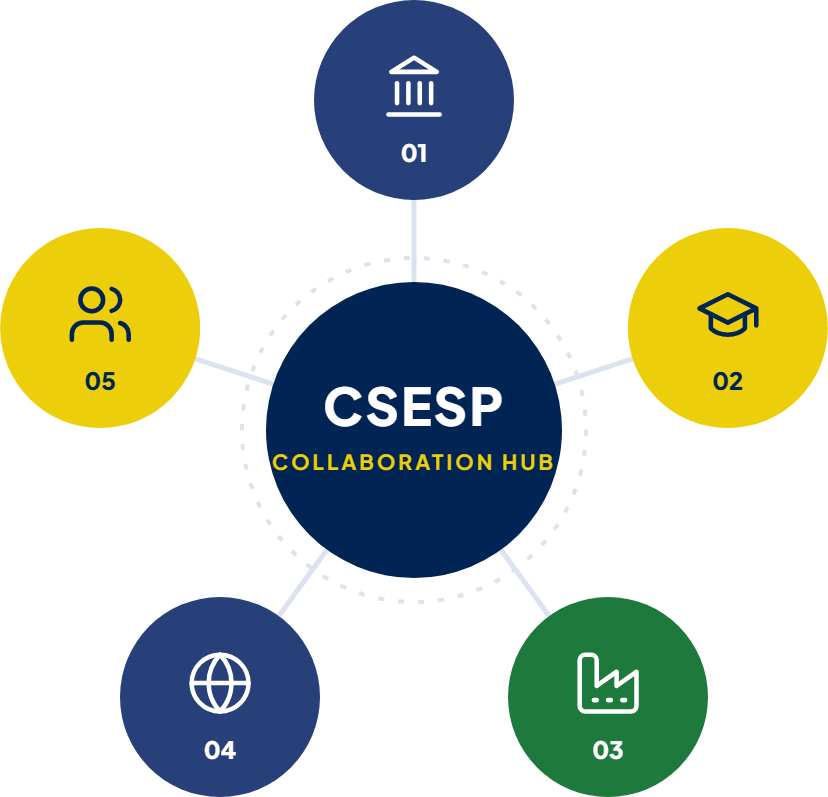
To strengthen the quality, relevance and impact of its research, CSESP consistently builds collaboration and partnerships that are strategic, inclusive and lasting. They are designed to create synergy between academia, government, industry and society in developing sustainable energy systems and in shaping policy based on scientific evidence.
Our partnership network covers five main groups of partners.
|
1
|
Government Institutions and Policy MakersEvidence-based input for energy and climate policy making.
|
|
2
|
Academic and Research InstitutionsJoint research, joint publications and collaborative student supervision.
|
|
3
|
Industry and Energy Sector PlayersApplied studies, technical assistance and decarbonization planning.
|
|
4
|
International Organisations and Funding AgenciesCollaborative programs and co-developed research proposals.
|
|
5
|
Non-Governmental Organisations and Civil SocietyKnowledge sharing and public engagement on sustainable energy.
|
Forms of collaboration
How collaboration with CSESP takes shape
 |
Joint scientific publicationsCo-authored papers in reputable journals.
|
Track record
| 2024 |
An integrated assessment of technological pathways and socioeconomic impacts for sustainable power system transition in Indonesia
Advances in Climate Change Research 15(6), 1107–1120
|
 |
| 2022 |
Implication of the Paris agreement target on Indonesia electricity sector transition to 2050 using TIMES model
Energy Policy 169, 113184
|
|
| 2020 |
Thermoeconomic assessment and optimization of wells to flash–binary cycle using pure R601 and zeotropic mixtures in the Sibayak geothermal field
Geothermics 85, 101778
|
|
Track record
2024
An integrated assessment of technological pathways and socioeconomic impacts for sustainable power system transition in Indonesia
Advances in Climate Change Research 15(6), 1107–1120
2022
Implication of the Paris agreement target on Indonesia electricity sector transition to 2050 using TIMES model
Energy Policy 169, 113184
2020
Thermoeconomic assessment and optimization of wells to flash–binary cycle using pure R601 and zeotropic mixtures in the Sibayak geothermal field
Geothermics 85, 101778
 |
Collaborative student supervisionCo-supervised graduate research.
|
Track record
Co-tutelle doctoral program
A jointly supervised program between Universitas Indonesia and IMT Atlantique that leads to a dual degree.
 |
 |
| Doctoral defense in the co-tutelle program | With the co-supervisors from the partner university |
Track record
Co-tutelle doctoral program
A jointly supervised program between Universitas Indonesia and IMT Atlantique that leads to a dual degree.
Doctoral defense in the co-tutelle program
With the co-supervisors from the partner university
 |
Advisory and consulting servicesTechnical assistance for decision makers.
|
Track record
Decarbonization roadmap for nine industrial sub-sectors
Long-term energy system planning models for energy-intensive industries, discussed with industry players and related associations in focus group discussions.
 |
 |
| Presenting the energy system modelling results | Focus group discussion with industry players |
Track record
Decarbonization roadmap for nine industrial sub-sectors
Long-term energy system planning models for energy-intensive industries, discussed with industry players and related associations in focus group discussions.
Presenting the energy system modelling results
Focus group discussion with industry players
 |
Joint research proposalsFor national and international funding.
|
Track record
Research collaboration in Japan
CSESP student Reviana Revitasari during her research collaboration in Japan.
 |
 |
| Research discussion with the host group | Group meeting during the research stay |
Joint publication on sustainable aviation fuel: Indonesia and Denmark

Final presentation of the power-and-biomass-to-liquid study
Track record
Research collaboration in Japan
CSESP student Reviana Revitasari during her research collaboration in Japan.
Research discussion with the host group
Group meeting during the research stay
Joint publication on sustainable aviation fuel: Indonesia and Denmark
Final presentation of the power-and-biomass-to-liquid study
Strategic Collaboration Hub
By strengthening this network, CSESP aims to act as a strategic collaboration hub in the sustainable energy research and policy ecosystem, and to strengthen Universitas Indonesia’s contribution to the energy transition at national and international level.
Become a partner
Have a research question or a program in mind?
Tell us about it and we will connect you with the right research group.

Center for Sustainable Energy Systems and Policy (CSESP) is an interdisciplinary research center under the Institute for Energy Transition, Faculty of Engineering, Universitas Indonesia.
 |
Website
sesp.ui.ac.id
|
 |
Email
labsesp2019@gmail.com
|
 |
Location
IDE (InterDisciplinary Engineering) Building, 5th floor, FTUI
|
Faculty of Engineering, Universitas Indonesia© 2026 Center for Sustainable Energy Systems and Policy